
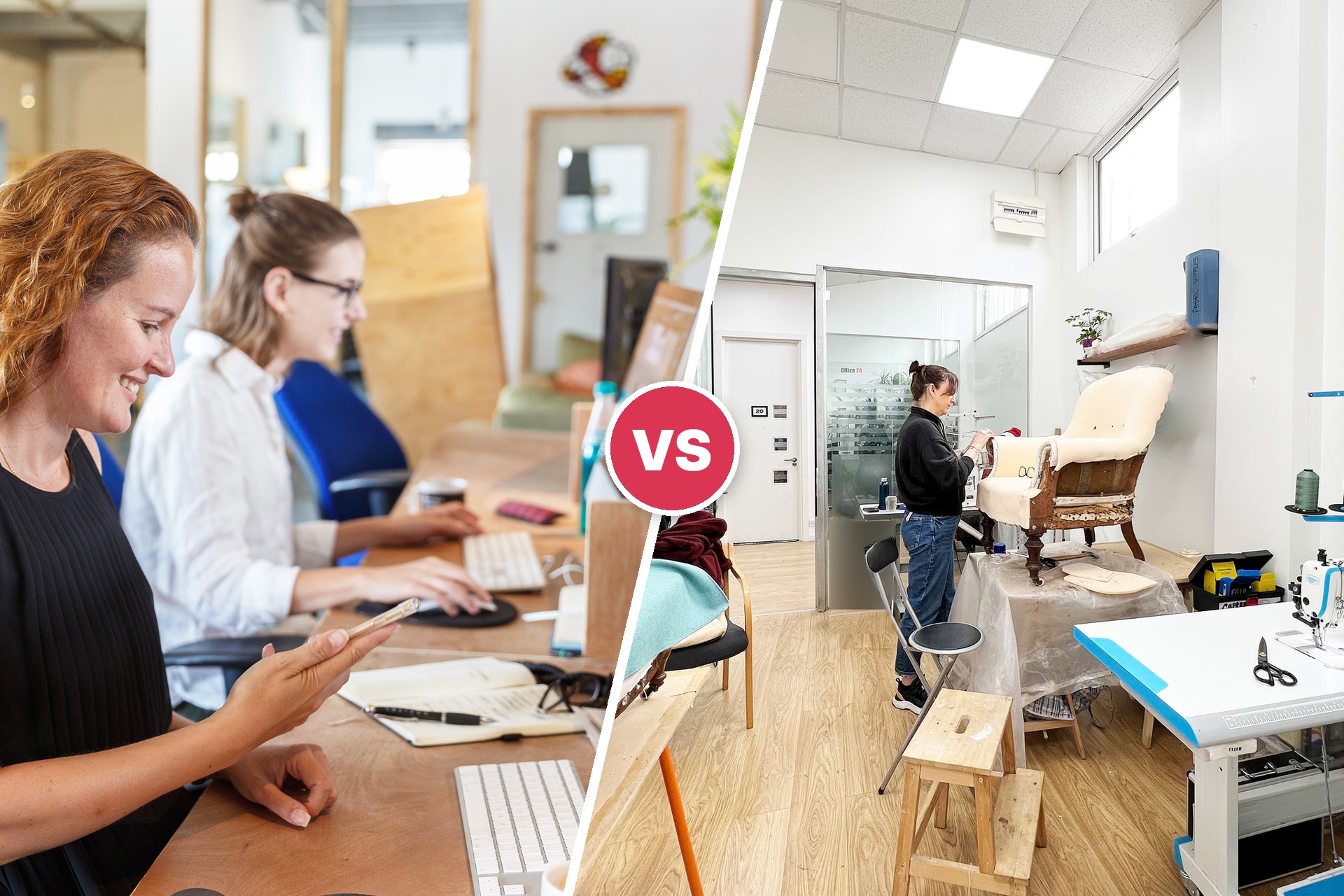
 Coworking vs private studios: which setup actually helps you get stuff done?
Choosing where to work can either speed you up or slow you down. If you are a desk-based freelancer, the right shared workspace can give you focus, routine, and a friendly network. If you are a maker or music producer, a private, lockable studio can be the difference between faffing with setup and actually shipping work.
This guide breaks down Mainyard’s two core setups so you can pick with confidence. We will look at focus, storage and gear security, mess and noise, client perception, access hours, and typical budgets. You will also see real scenarios so you can map your day to the right space.
Spoiler: start lean, then upgrade when your workflow demands it. You can always move within Mainyard as your practice grows.
What coworking means at Mainyard
A coworking space is a shared workspace with proper desks, good Wi-Fi, and a like-minded community. You bring your laptop, plug in, and get to work. At Mainyard that can mean hot desks for flexible days or a dedicated desk you can treat like your base. You are surrounded by other freelancers and solopreneurs who are writing, coding, designing, editing, and building businesses.
What can you do in a coworking space? Most desk-first tasks. Think UX design, copywriting, bookkeeping, client calls, content planning, light video editing with headphones, and proposal writing. You get meeting room access for client chats, plus kitchen areas and community events to keep you plugged in.
How is it different from a traditional office? Offices are private rooms leased by a single company for their team. Coworking is shared by individuals and micro teams on flexible memberships. You still get a professional setting, but without the long leases or high overheads.
Is it worth renting an office? It depends on your work. If your day is mostly calls, writing, and meetings, a dedicated desk or small private office can be worth it for consistency and client-ready presentation. If your work is messy or loud, skip the office and head straight to a private studio.
For a sense of the offer, explore our coworking pages for co-working spaces in London and hot desks in London that match different schedules.
What private studios mean at Mainyard
Mainyard’s studios for creatives are always private and lockable. There are no shared, open creative studios. You get a room you can kit out for music, podcasting, fashion, art, fabrication, or product builds. Many sites offer 24/7 access, so you can work when inspiration hits.
We also run purpose-built soundproof rooms for audio professionals. If you record, mix, teach, or podcast, our soundproof studios in London provide reliable isolation that typical offices cannot. You can read more and check availability for music studio rental if you are weighing up a move from a bedroom setup.
Focus: how you actually get through the to-do list
- Coworking desks: Great for structured computer work and routine. You are in a shared room, so normal office-level noise applies. With headphones, most people find a solid flow. Choose a dedicated desk if you want to leave a monitor and keep a small locker of essentials.
- Private studios: Best for deep, uninterrupted making. Shut the door, roll out the cutting mat, switch on the compressor, or patch in your synthesiser. Soundproof music studios add acoustic control so you can record or mix with confidence.
Storage and gear security
- Coworking: Light storage only. Bring your laptop, a small toolbox, maybe a monitor at a dedicated desk. Heavy gear, solvents, timber, or racks of garments are not a fit for shared rooms.
- Private studios: Designed for equipment, materials, and works in progress. Lock the door, leave the rig patched, and save 30 minutes of setup time every session. Makers can store rolls of fabric, tools, or prototypes. Musicians can leave mics, interfaces, and outboard safely in place.
Mess, noise, and safety
- Coworking: Clean and quiet by design. Food wrappers, yes. Sawdust, spray paint, or amps cranked to 11, no.
- Private studios: Mess and noise are expected within reason. Fashion designers can cut and pin. Artists can prime canvases. Fabricators can bench-assemble parts. Audio creators can track vocals, rehearse, or edit without bleeding into neighbouring rooms in soundproofed units.
Client perception and professionalism
- Coworking: Ideal for desk-based client work. Invite clients to a meeting room, present on a big screen, and grab coffee in the kitchen. It signals you are part of a creative community and take the work seriously.
- Private studios: Perfect when your work speaks through space and gear. A client stepping into your music room or maker studio immediately sees your capability. Teachers and collaborators will appreciate a tidy, private environment.
Access hours and rhythms
- Coworking: Day passes run on business hours; full-time and dedicated desks often include extended or 24/7 access depending on the site.
- Private studios: Many locations offer 24/7 access for full-time members. Late-night mix, early pattern cutting, or weekend production sprints are all possible.
Typical budgets and how to choose
Budgets vary by size and location. A practical rule of thumb is to keep workspace spend around 10 to 15 percent of your monthly revenue when you are being lean. Maintain a few months’ fees in reserve. If you are not using the space at least 70 percent of your planned hours, consider scaling down. When in doubt, start with the smallest option that fits your core workflow and upgrade when you are bumping into limits.
Real-world scenarios to help you decide
- UX freelancer on a dedicated desk: You run three client projects, live in Figma and Notion, and take two calls a day. A dedicated desk gives you a stable base, an external monitor, and quiet corners for calls. You book meeting rooms for onboarding sessions. This is classic coworking territory.
- Garment maker in a private studio: You need a cutting table, a dress form, two machines, and shelves for rolls and trims. You also need to leave everything out between fittings. A private creative studio fits, keeps your workflow intact, and protects stock.
- Podcaster upgrading from home: Your co-host joins twice a week. You need reliable acoustics and somewhere to leave the mics up. A soundproof music studio unlocks consistency and a more professional sound without rebuilding your spare room.
- Artist prepping a show: You are working on large canvases with drying times. You need wall space, storage, and regular late nights. A private studio gives you the room and the lock you need.
If you want to see what is nearby, explore our creative studios in London or browse purpose-built options for a music studio to rent in London. If East London is home, our Hackney Wick studios are a good starting point.
Quick FAQ
- What is the concept of a coworking space? A shared workspace where independent professionals work side by side, with desks, Wi-Fi, meeting rooms, and a community, paid for on flexible memberships.
- What can you do in a coworking space? Most computer-led tasks like design, writing, coding, editing, client calls, and small meetings. Light gear is fine; messy or noisy processes are not.
- What is the difference between coworking space and office space? Coworking is shared by many individuals or small teams on flexible terms. An office is a private room leased by a single company. Both can be professional, but coworking offers more flexibility and lower commitment.
- Is it worth renting an office? If you need privacy for calls, team collaboration, or client meetings, a private office or dedicated desk can be worth it. If your work involves noise, mess, or specialist acoustics, a private studio or soundproof music room is a better choice.
Where Mainyard fits in London
Across London, Mainyard offers private studios for makers and musicians, plus shared coworking for desk-based work. If you want a sense of neighbourhoods and options, you can browse our shared workspace in London, or head straight to locations such as workspace Mare Street if Hackney is your base. For audio creators, explore soundproof studios in London to compare room types and availability.
Start small, then upgrade when your workflow demands it
The best first step is the smallest setup that gets the work done. If you are desk-first, try a hot desk or dedicated desk, then move to a private office if calls and client sessions ramp up. If you are a creator with tools or instruments, start with a compact private studio and scale as production grows.
Ready to see spaces in person? Book a viewing at a nearby Mainyard location and we will help you find the room that lets you get more done with less faff.